Tuesday, April 3, 2012

Sio May Bandung

When I say "sio may" I don't mean anything related to dim sum. This fish-dumpling-potato-and-egg-smothered-in-peanut-sauce dish is said to have originated in the city of Bandung on Java. It's very popular in Pontianak though I've been told that the traditional way of eating the fish dumplings are stuffed in bitter gourd (or bitter melon, whichever name you prefer) and I've never seen it served that way over here. This was one of the more novel dishes I've encountered while in Indonesia, so I was pretty excited to learn how to make it! It's super easy, actually.

My first sio mai bandung: at a restaurant on an adjacent street to my house.

Kind of like pecel, sio may bandung is a bunch of different things with a hearty helping of peanut sauce blanketing it all. We made a variation of the peanut sauce used in the previous recipe, and I'll outline that below.


Serves 5-6 people
Ingredients
500g pureed tenggiri (white fleshed fish, I think it's a type of mackerel)
5-6 large cloves garlic
3 tsp salt
1/2 tsp pepper
6 heaping spoonfuls cassava flour
6 heaping spoonfuls all-purpose (wheat) flour
2 eggs
A bit of oil
Medium/hard tofu (optional)
Bittermelon/bittergourd (optional)
Hard boiled eggs (1 per person)
Boiled potatoes (1 or 1/2 per person)
About 1/4 head of cabbage


Directions
1. Prep the hardboiled eggs and potatoes and skin/peel them ahead of time. Let them cool.
2. Grind the garlic, salt, and pepper together with a mortar and pestle.
3. Mix the liquidy garlic paste into the pureed fish. Add the two flours and two eggs. Gently combine until the mixture is a soft dough, stretchy and holds its body. You may need to add some water.


4. Lightly oil some small 1.5” molds, if using molds. You may use molds or stuff tofu or bittergourd. You could use ramekins, shot glasses, muffin pans, depending on your steaming apparatus.


5. We filled about 14 molds with about 2 spoons of paste, a dozen triangles of tofu with about one spoon of paste, and one bitter melon cut into 5 rounds with a spoon of paste.
6. Steam until a toothpick comes out clean, about 20 minutes.
7. At the same time, steam the cabbage leaves.


8. Sio may bandung is a plate of the sio may fish dumplings (in tofu or bittergourd), boiled eggs and potatoes, and cabbage leaves smothered in peanut sauce.


We used a milder, less fragrant peanut sauce this time. It was similar to the last one we made, but we crushed only shallots, garlic, salt, and chilis (no galingale, lengkuas). We then fried that and eventually added the ground peanuts, mixing it all together, then adding the leaves and water directly to the wok. 

Friday, March 30, 2012

Gasoline Protests


Protests have spread over most of Indonesia as people are upset that the government is reducing the gasoline subsidy. I think that's what this was? There were lots of banners and different political party flags so I wasn't exactly sure but most things indicate that this was another protest about fuel. Peaceful, though, and I've been careful so don't concern yourselves unnecessarily.

Sunday, March 18, 2012

Hekeng: Chinese Indonesian deliciousness

Hekeng is one of those Chinese Indonesian foods that I'd never heard of or tasted before coming to Pontianak. The "e" in "he" is like the one in "red", and the second syllable is deeper, more like the "u" in "cup", with the "ng" dropping into a more throaty sound, the way all "ng"s are in Indonesian and Malaysian.


Hekeng is kind of like a soft-ish dumpling, siu mai-like, made in rolls, steamed, and then sliced. Generally the slices are then fried and served with a honey-like lime syrup (though it tastes more like apple juice syrup to me).

(It's those fried golden brown slices on the left)

The mother of one of my coteachers showed me how to make it today. I've been asking her to show me for months, and finally they decided to make it again and allowed me to hang around while they whipped it up. In a pretty typical Indonesian style my coteacher gave me about 20 minutes heads up; I spent the next few hours at her house being over fed and chatting it up with the family. Not a bad way to spend the early afternoon!

This recipe makes about 25 six inch rolls, which is a lot. When I get back to the states I'll figure out how to downsize it to about 3 logs or so and maybe then repost this recipe. Also I have photos (of course!) but I don't have good enough internet to post them yet so I'll do that tomorrow.

Ingredients
1 kilo shrimp, shelled and cleaned
600g pork fat
2.5 tbsp white pepper, ground
2.5 tbsp salt
1.5 cups minced garlic
1/2 cup shallots, cut into thin pieces
3/4 cup green onions/scallions, thinly sliced (white and green parts both)
10 eggs
1.5 to 2 cups wheat flour (any flour would probably be fine)
3 sheets bean curd (you can use banana leaves, but then you can't eat that part, obviously)


Directions
1. Mince the shrimp and pork fat together.

Mincing here is an arm workout with a cleaver.

2. Over medium heat fry the garlic, stirring often. Remove the garlic when it is a semidark golden brown and crispy.

That's a lot of garlic.

3. Mix the ground white pepper into the shrimp and pork fat. Add the cooled garlic and the shallots.
4. Stir in the eggs. Once everything is combined, stir in the flour. Lastly, add the green onions. The mixture should be wet but not overly so. Sticky and fragrant.


5. (It's a good time to get the steamers ready) Cut the bean curd sheets into lengths about 6 to 7 by 4 inches long. It's approximate, but make them as consistent with each other as possible. We also cut off the edges.
6. Heap 2-3 spoonfuls of mixture onto a bean curd rectangle. Use the spoon to distribute the mixture evenly along the length. Pull up the edges of the bean curd such that they almost touch. No rolling or anything should be necessary; the mixture retains its shape but is too soft for much shaping.


7. Put the logs into the steamer, seam side up. Cook until the insides are no longer sticky, about 15 to 20 minutes. A toothpick should come out clean when poked into the hekeng.

Waiting to be steamed!

8. Slice the hekeng and eat as is, if desired. Usually people slice it and then fry it. If you fry it, you don't need lots of oil. The high fat content helps it fry easily. Unless it's made fresh you'll eat it at a restaurant fried to a crispy golden brown.

Steamed and ready to slice!

Tuesday, March 6, 2012

Authors: Have Some Faith in Humans?

Humans have done some pretty crazy things! Technology today is crazy awesome. Sure, we don't have hovering skateboards yet, but take a moment to consider what you use in your daily life. Think about the people who invented them and the people who discovered the scientific principle or method that allowed you to hold that amazing computer in the palm of your hand. Think about the awe inspiring music you heard last week and the historical figures whose actions blew your mind. There's a lot to admire in the history of human kind.

I don't want to go overboard waxing poetic about humans because our egos are much too inflated as it is. Probably it's this pride that leads me to write out this rant in the first place. Because in the last week I've encountered this on several occasions, and well, it galls me a bit when stories attribute genius or extraordinary human accomplishment - even infamous human beings - to "well, another race mixed with yours". 

Earlier this week I read I Am Number Four by Pittacus Lore. I know there's a movie out but I've never seen it. If you've not read it but recognize the title perhaps it's from the film. Slight spoiler alert, by the way. It's not much of one because it's stated on the first page that they're from another planet. At any rate, the protagonist is of an alien race (the Loric) that looks and talks just like humans but is just superior in a million ways. They've influenced Earth in lots of ways throughout history, like building the pyramids. One of the characters explains:

"Some of the greatest figures in Earth’s history were actually the product of humans and the Loric, including Buddha, Aristotle, Julius Caesar, Alexander the Great, Genghis Khan, Leonardo da Vinci, Isaac Newton, Thomas Jefferson, and Albert Einstein. Many of the ancient Greek gods, who most people believe were mythological, were actually the children of the humans and Loric, mainly because it was much more common then for us to be on this planet and we were helping them develop civilizations. Aphrodite, Apollo, Hermes, and Zeus were all real, and had one Loric parent."

Percy Jackson, which I had a long rant about earlier, does this as well. While discussing about the demigods, or half mortal half Greek gods, one character says, "A few manage to survive in the outside world and become famous. Believe me, if I told you the names, you'd know them." That's when the character mentions that Hitler is the offspring of Hades and that's two whammies right after each other on my exasperated-sigh-o-meter.

A third very silly example comes from the movie Ghost Rider 2. Yes, I actually saw Ghost Rider 2, and, well, it was... yeah. That happened. I suppose I should give another spoiler warning right now but it's a really minor part of the background, and also who will read this who really cares about spoilers for Ghost Rider 2? Anyway, part of the Nick Cage voiceover describes how the devil has appeared in many human forms throughout time. Different historical figures flash up on the screen. I wasn't sure who else in the theater got all of the references, some of which were supposed to be amusing - my students, who saw it with me, certainly didn't. A few of them were great dictators, like Stalin. Really? I mean, I don't presume to know anything about the devil and his personal choices, but I don't think it'd be a wise choice to be in the hot spot like that. More conniving and safer to be an advisor or manipulator, like the devil on their shoulder, I suppose. Why would the devil put his earthly visage into such a risky and high visibility position as someone like Stalin?

Aside from that, are humans incapable of great evil on their own? Are we not responsible for our own mistakes, our own genocides, and the way we treat our own flaws? All of these people and their actions and thoughts are part of our collective history.

With all of these examples, I think that bothers me is that implication that humans are so ordinary and can never, or have never, or perhaps just rarely, produced extraordinary beings of their own. Those moments in history that where humans shone or completely wrecked things are not human. Human nature didn't lead to them, as we often say. Humans stay in the middle ground, always. If there was something notable it was because aliens or gods, or the devil himself, produced the people responsible.

As an ordinary human being I have to believe that mankind has the ability to burn brightly or burn itself down. It is our own actions and the environment created by our society that lead to who we are and what we do. Humans can hope to achieve things as great as those they admire who came before, or avoid the paths that lead to notoriety of others. Taking that away from us and saying that those "anomalies" were not human but due to other forces is, in my mind, just going to make the human race boring or looking for an easy way out.

Stop Abusing Greek Mythology

I started writing this before I realized that just a few posts ago I wrote about reading and mythology. Appropriate! Some of my reading recently has brought up pet peeves related to mythology and such (okay, this is basically a rant about the Percy Jackson books). So here we go, me being on my soapbox for what will probably be too long for most people.

I loved Greek mythology in elementary and middle school. The Greek Gods, unlike those in most depictions of other pantheons (and current religions), have a great deal of human flaws: arrogance, immaturity, jealousy, inability to play well with others, and a general lack of social skills. It made the tales more tangible, their morals more relatable, even if the story involves factors you'd never worry about in yours: outrageous quests, sorcery, creatures of questionable biological feasibility. They plot and move against each other and use humans like literal pawns in a globe spanning chess game. Though the gods often emerged on the other side unchanged, being gods of an eternal nature, us lowly mortals could learn from their mistakes. Lessons about impatience, acceptance of events past, and the origins of flowers/seasons/sound phenomena, etc. Consequently, it bothers me a bit when people steamroll through the Greek gods and mold them into cookie cutter characters.

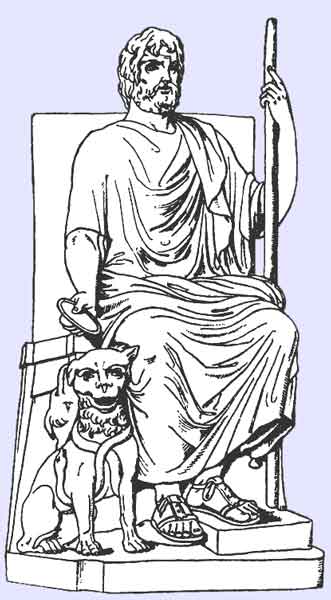
What particularly grates on my nerves is the depictions of Hades. Hades rules the Underworld, but it's not the fire-and-brimstone eternal furnace many people think of when they think of hell. It's both heaven and hell, the afterlife for everyone, with fair and just reward. As a kid, and I suppose still now though the stories are not so fresh in my mind, I admired that Hades kept out of the petty squabbling of Mount Olympus, choosing to stay in his realm and, from what I remember of the stories, choosing to do his duty and ignore the scheming and wars going on in the world above. Though many mortals feared him and he was known for being unpitying and stern, he was also known as being just and fair (picture of Hades, Villa Borghese, Rome).

He lacks some social skills, sure - once he was enamored and kidnapped a girl but it seemed, from my young perspective, more like he just didn't really know how to approach her. His treatment of her once in the Underworld was polite and rather sweet, though he didn't understand what she wanted, really. I'm not saying he went about things in any sort of correct way, but he didn't, for instance, turn himself into a golden rain and impregnate someone. If you've got issue with Hades and Persephone but like Beauty and the Beast's love story I don't get you.

After getting the recommendation a few times while here in Indonesia, I finally got around to reading Rick Riordan's first Percy Jackson book. I'll admit, I'm not done with the book yet, and I'll probably finish the series within a week or two. But, when I read this, you won't be surprised that it irked me:

"World War II, you know, that was basically a fight between the sons of Zeus and Poseidon on one side, and the sons of Hades on the other. The winning side, Zeus and Poseidon, made Hades swear an oath with them: no more affairs with mortal women."

Seriously? Hades' kids are literally Hitler, Stalin, and Rasputin. Zeus's kids include Roosevelt and Poseidon is Churchill's father.

Hades seems, of all the gods, the most stringent with the rules - not only did he try to be fair but he expected justice of others, as whenever he had cause to go to Zeus about something. Rick Riordan uses that, plus him harboring grudges, as the reason that "Hades let the worst monsters out of Tartarus to torment" breaches of the above agreement. That doesn't seem very characteristic to me, and it bothers me a little, but I'm giving the book the benefit of the doubt and reading on. Most things have been learned through third parties, we've not yet met Hades ourselves. Still, the him-being-Hitler-and-Stalin's father seems a little silly to me.


Disney's Hercules is another fantastic example (I know, I know, Disney is notorious for taking extreme liberties with source material and characters that can only live at extremes). Putting aside that it totally ignores most of Hercules' story and personality, the depiction of the Greek Pantheon can be boiled down to the colors used with them: golden, glowing, and glittering for everyone in Mount Olympus and dark, pale, snuffy fire for Hades.

Took this from fanpop.com, copyright Disney, etc etc


Zeus and Hera are smiley, loving, and affectionate parents who resemble a fit Santa Claus and a silent magazine model. Hades is a coward who relies on two bumbly minions to do the dirty work, gets explosively mad, and is scheming and conniving but also totally fails at it, making him look stupid and incompetent as well. Hades in Percy Jackson's world is at least a force to be dealt with? He is essentially a ninja that radiates intense fear so intense it'll stop someone's heart.

The songs in the Disney movie are fun and the movie is lively. I just wish I could watch it without cringing at their trampling all over Greek mythology. I have enough respect for the source material that it makes me sad that what most people will know of The Little Mermaid, Pocahontas, Beauty and The Beast, and yes, Hercule's stories are the reworked Disney versions. Then again, how many people would know the original stories if they hadn't been made into Disney movies? I dunno. Expand that into all movies-based-on-books and ask my Indonesian students, who almost unanimously never pick up books and infinitely prefer movies, and you make me sad.

(Yes, I know, most American teenagers, and well, maybe most people older than that, too, don't read that much but I would still call us a reading culture. Americans at least read books for school, we study literature and people often lament not reading more, or have book lists, and I can talk extensively about books with lots of people. Generally, Indonesians don't like reading anything. Yes that's a huge generalization I understand and it -the generalization, I mean - bugs me more than it bugs any of you, I think.)

In a more general sense, the Percy Jackson world lacks the nuance that I appreciated in Greek stories. It's a young adult novel, I get it, but I read a ton of those and they don't need to be so cut-and-dry, so black and white. Among other things, I feel like Rick Riordan completely threw the nature-versus-nurture idea out the window and went with "It's all genetics". The half-blood progeny (first word that came to my head, I'm a bio nerd, sorry) of gods and mortals that you meet in the book are pretty identical and ridiculous in precisely the same ways. Yes they're background and not much time is spent on them but seriously could characters get any more 1 dimensional (yes I am a physicist I know that makes no sense)?! Every kid of Ares' is a brutish, war thirsty bully. Aphrodite's kids are constantly checking their looks and obsessing about physical appearance.

Also, maybe I've been reading too much Sandman but I don't think the Furies, which Percy's friend Grover describes as "the worst monsters from the Underworld", are so stupid as to be tricked by a hat that makes you invisible and can be defeated by an inexperienced fighter swinging a sword around. Yes, the sword is magical, but it wasn't described as auto-aim.

I have another rant that goes with this, but after writing it out I realize it's a bit long, and the above tirade ain't no breeze

Monday, March 5, 2012

Things Get Cookin'

It's been raining all week, which is fantastic because it's been scorching otherwise. Last night was actually decently cold! Today (okay more like yesterday because I'm publishing it onto the blog a day late), I had a laid back Sunday working, making a small dent in my hot cocoa stash, catching up on my journal, actually playing a bit of a video game, and taking all afternoon to stew some home made chicken stock. I haven't brewed my own stock since Vancouver - partially because I don't really cook meat much - but it's always awesome when I get a chance. I did today thanks to Cooking Club.


Yesterday the Cooking Club cooked pesto with twisty pasta and chicken nuggets. The chicken nuggets are a variation of a baked cereal-encrusted garlic chicken I've made a few times (which Jeff has named “Awesome Chicken”). Since we have no ovens I had the students cut up the chicken into little pieces and fry it instead. They brought three whole chicken torsos, from which I sectioned the breasts. The remaining bones and whatever meat is what I made the chicken stock with.


Is it even necessary to elaborate? It was incredibly tasty. Snatched up before they could cool down enough to not burn the tongue. “Better than ones you can buy!” they sang. Awesome.

Their reaction to the pesto was much more hesitant.


So far Cooking Club has made:


Dark Chocolate Salt Truffles
They were really surprised by the salt. It worked really well especially because the dark chocolate here is super waxy and doesn't harden in a satisfactory, crunchy coating way, so the truffles were more like a blob of


Lemon Curd
I got my hands on lemons! They are very lemony. The curd was pretty sour, in a way that I totally loved but the kids were a little hesitant about. Like the American Corner lemonade, I suppose – all the Americans thought it was refreshing and Indonesians mostly thought it needed more sugar. I should have brought some cake or bread to spread the curd on, but instead I had brought little containers and we distributed it and they took it home to cool further and spread on stuff.

Apparently I also forgot to take pictures. You'll have to use your imagination!

Homemade Caramel (and apples)
Same recipe as for Fall-o-ween. Not all of the students had gone to the event, and the only specific request I got when talking about what we could whip up was this. I thought one batch was a fair amount of caramel, but they were clamoring for more.


French Toast
I thought it'd go well with the caramel and apples. The bread they brought were these really soft hot dog buns, which made for pillow-y french toast. The students were also super afraid of browning the french toast and I had to convince them to let the bread cook longer, so that the egg was actually cooked.


aand, the pesto and chicken nuggets, of course.


What'll we make next? "Anything we can't get in Pontianak" they'll go for. Contemplating making daal bhaat, moving one session over to a student's house to use their oven to make a selection of cookies and maybe a pie (keeping a cold dough for the crust is the tricky part) or cake, some creamy soup, sandwiches of some sort (no luncheon meat though) possibly grilled, perhaps a meatloaf, chili, or sloppy joes, something with potatoes? Maybe I can teach them how to make tortillas and we'll make breakfast burritos. Any suggestions?

Friday, February 24, 2012

Small Gods

Mythology is fascinating. I absorbed it in school and tons of books play with it in very interesting ways. If you have spare time you should read books by Neil Gaiman like the Sandman graphic novels or American Gods, for starters. Last semester I read almost every Neil Gaiman book that I hadn't yet gotten to. Thanks to the recommendation of a few other ETAs, I finally got around to Terry Prachett's Small Gods a couple weeks ago. It's a really fantastic book and I grabbed a few quotes from it to share with you guys:

"Humans! They lived in a world where the grass continued to be green and the sun rose every day and flowers regularly turned into fruit, and what impressed them? Weeping statues. And wine made out of water! A mere quantum-mechanistic tunnel effect, that’d happen anyway if you were prepared to wait zillions of years. As if the turning of sunlight into wine, by means of vines and grapes and time and enzymes, wasn’t a thousand times more impressive and happened all the time…"

"Every five years someone was elected to be Tyrant, provided he could prove that he was honest, intelligent, sensible, and trustworthy. Immediately after he was elected, of course, it was obvious to everyone that he was a criminal madman and totally out of touch with the view of the ordinary philosopher in the street looking for a towel. And then five years later they elected another one just like him, and really it was amazing how intelligent people kept on making the same mistakes."

Now I'm rereading some 19th century stuff, and going through a list of books Pitzer students compiled at the end of my senior year on our student wide email. Good stuff!

At IBC we're teaching our kids about literature (just the idea of it, really, we can't teach our kids literature) and we've had a few classes about poetry. We spent all day today writing haikus and limericks, because I'm awesome. I can rattle off haikus pretty fast now. A skill to add to my resumé?